Centauri Dreams
Imagining and Planning Interstellar Exploration
Microbes on Enceladus?
Until we get more assets in orbit around Saturn, we’re left to studying Cassini data on the fascinating moon Enceladus, findings that have already revealed much about geyser activity at the moon’s south polar region and its implications. New lab work is now procovative, as Alex Tolley reports in this morning’s essay. While we cannot claim a detection of life, it increasingly appears that the same kind of hot vents that allow life to flourish on the ocean floors of Earth produce nurturing conditions on Enceladus as well. Could an Earth organism survive in the rugged little moon’s ocean? As Alex explains, the recent experiments are more than a little encouraging. If a future mission finds evidence of microbes in the Enceladan ocean, we will have not only proven that life exists on another world, but that conditions common on icy moons may support living systems throughout the outer system.
by Alex Tolley
Introduction
Last year, 3i/Atlas, the interstellar comet, eclipsed the important reanalysis of the Cassini plume data. While the news speculated about whether Atlas was an alien probe, a Nature Astronomy paper concerning the reanalysis of the Cassini plume particles found a host of interesting organic molecules, more complex than hitherto found. Rather than simple molecules like methane (CH4), the analysis using mass spectrometry detected evidence of more complex multi-carbon compounds of different types, as shown in Figure 1. Click this image from the paper to enlarge it.
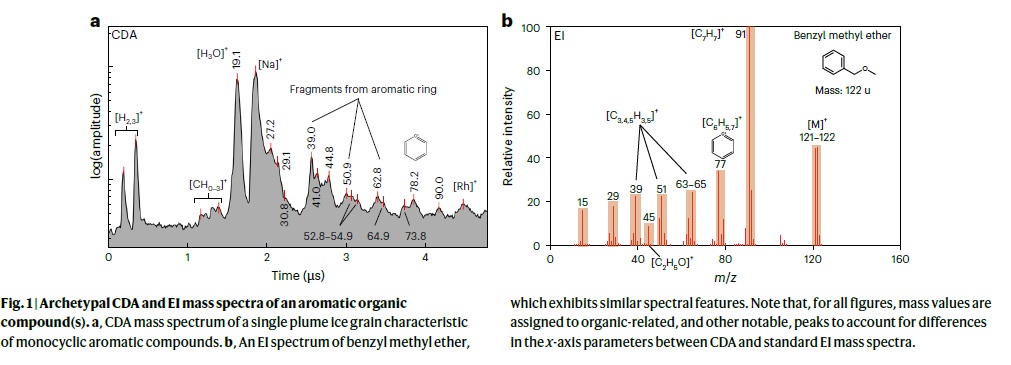
The carbon structures detected implied that more complex molecules existed in the plumes, but most interesting was that these structures are also part of biomolecules. In other words, some of these molecules could have come from organisms. Had Cassini found possible biosignatures of organisms that had been ejected from the sun-surface ocean?
Unfortunately, the molecules were not a smoking gun. All of them could have also had an abiotic origin, and not one required a known terrestrial biological synthesis route. The paper included a diagram showing the possible origin and pathways. Examination of the image shows that there are no definite biological molecules found, nor any biochemical pathway between the putative compounds. At best we might have another ambiguous biosignature.
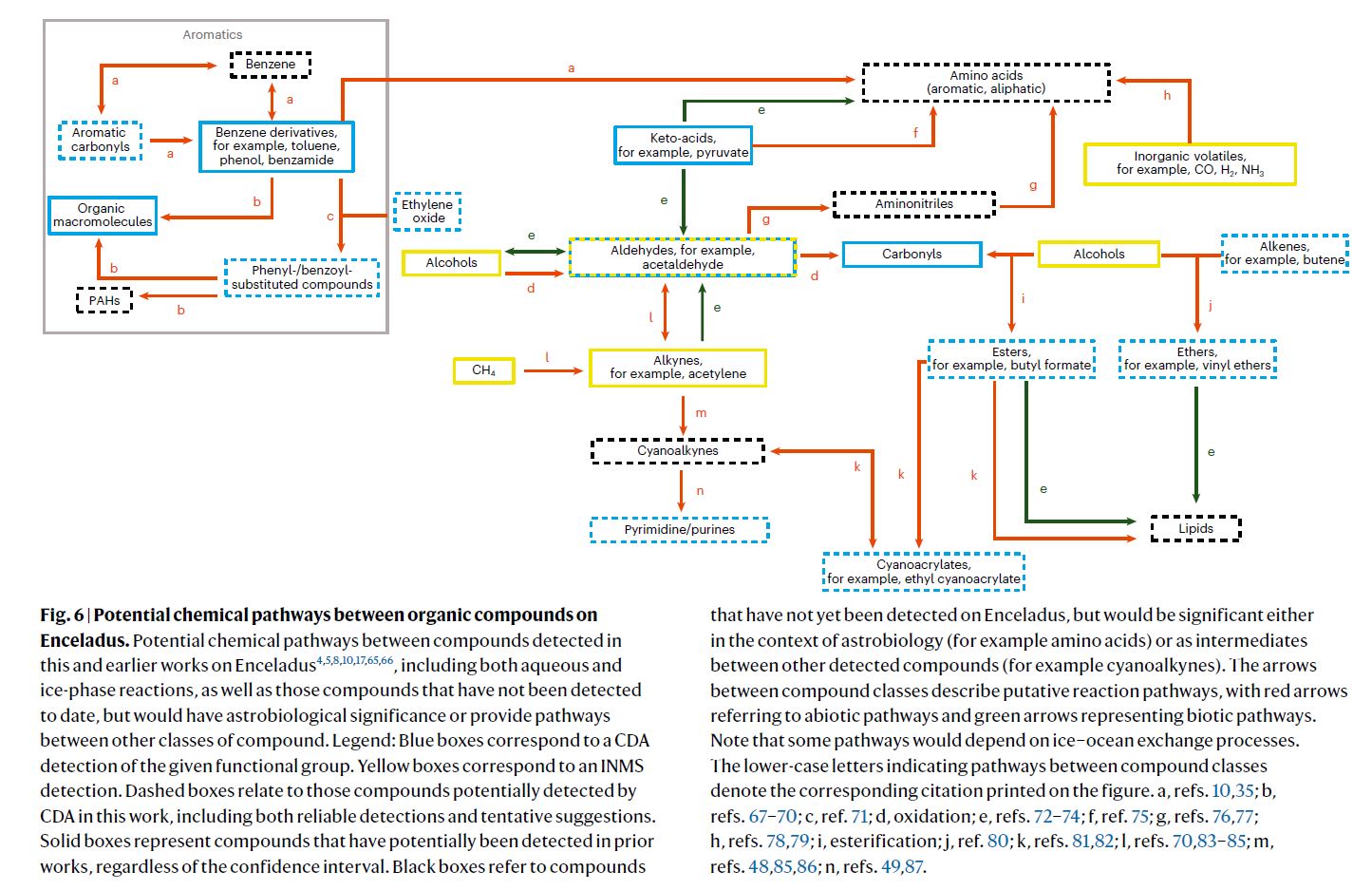
Figure 2 (click to enlarge). The structures, possible molecules, their origin, and pathways between them. No biological molecule was found, nor any biochemical pathway between the detected structures. (The original caption is included to explain the diagram),
An intriguing finding, but “no cigar.” An ambiguous finding that we must expect at this stage of biosignature detection.
Enceladus as an Abode for Life
Before I go into the microbe growth experiment, I should explain why Enceladus may be an interesting abode for life. The obvious, and simple, answer is NASA’s mantra “follow the water”. The shape of the Saturn-originated magnetic field data around Enceladus is best interpreted as due to a liquid ocean. The plumes that were detected at the South pole were largely composed of water ice, so we know that this ocean is large and must be above freezing, unlike the frozen ice crust above it. The plumes must be getting their energy from somewhere, and the best hypothesis is from a hot, rocky core.
Surface temperatures on Enceladus show that the South Pole is warmer than the rest of the surface, indicating a hot spot below that drives the plumes, rather like the Old Faithful geyser at Yellowstone National Park. Why should Enceladus have a hot core? It is a small moon, about 500 km in diameter. Any radioactive elements should have long since cooled. The best explanation is that tidal forces squeeze Enceladus, keeping at least pockets of the core hot. The thinking goes that ocean water seeping into the rocky core is heated and forms hot vents of a similar nature to those in the Earth’s oceans. As the Earth’s hot vents are surrounded by life from bacteria to complex life, so Enceladus’s ocean vents may also support life. One dominant hypothesis of Earth’s abiogenesis is that the conditions at the alkaline rocks at Earth’s hot vents create the needed hydrogen (H2) coupled with dissolved carbon dioxide (CO2) to provide the needed energy via methanogenesis for prokaryotic methanogens to grow. The archaea prokaryotes are predominantly methanogens and possibly the earliest form of extant life that emerged at these vents.
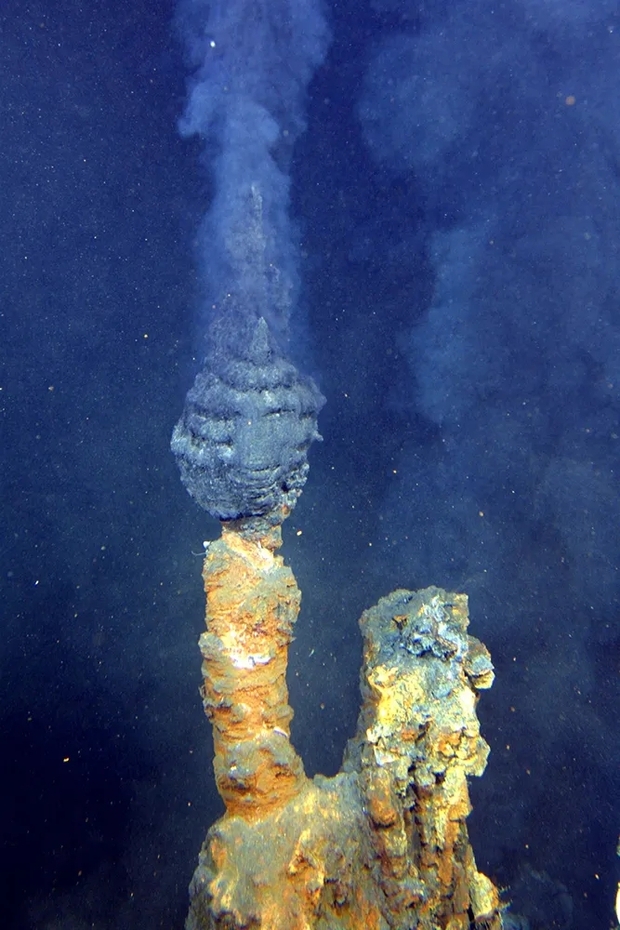
Image: Hot vent on Earth. Credit: NOAA
Are the Enceladan vents similar to Earth’s? The main difference is their temperature. On Earth, the vent water emerges around 400°C, whilst it is calculated that on Enceladus, the temperature is closer to 90°C. This makes little difference as the temperature rapidly declines away from the vent, much as the energy from a star declines with increasing orbital distance.
The ocean on Enceladus is 16-31 km deep, with an overlying ice crust of 20-25 km. However, as the gravity is just 1% of Earth’s, the pressure at the bottom of the ocean is equivalent to just 400-650 m on Earth, compared to Earth’s average ocean depth of 4 km. Therefore, we have a temperature and pressure at the Enceladan vents that are well within the range of Earth’s.
There is one difference from Earth’s ocean. The alkalinity of Earth’s oceans is generally neutral (pH 7) to mildly alkaline, although becoming more acidic due to increasing CO2 emissions. In some vent fields, the pH is as high as 8 [1]. By comparison, Enceladus ocean water is more alkaline with a pH of 11-12. Due to more sodium carbonate (Na2CO3) [2]
Growing terrestrial organisms in simulated Enceladan ocean medium
This year, the same team published a paper asking a different question. Could life be extant in the Enceladan ocean to create the detected organic compounds by Cassini? While we still await any possible future discovery of life, it is worth asking whether terrestrial life could survive and reproduce in the conditions of that ocean. If they can, then this proves that life could exist on Enceladus. If life were to exist in the ocean, it likely would occupy the same sort of hot vent habitat that microbes and complex life are found around Earth’s hot vents.
The first step was to concoct a simulant for the Enceladan ocean, an alkaline salt mixture [sodium chloride (NaCl), sodium carbonate (Na2CO3), and sodium bicarbonate (NaHCO3) with crushed rock that mimicked the likely rocky core at the base of the ocean. To simulate the hot vent, the ocean sample was kept at 65°C. This is a temperature that is too hot for most terrestrial organisms, except for thermophiles adapted to high temperatures. What sort of organisms would be suitable to test? The authors chose an archaeal methanogen that could extract energy from H2 generated by the serpentinization of the rock and the dissolved CO2. The chosen organism, Methanothermococcus okinawensis, was acquired from an ocean hot vent in a Pacific trench near Japan.
The Enceladan ocean simulant [EOS] was made to test 5 pH levels, 9, 9.5, 10, 10.5, and 11, and incubated with the microbes. The controls were an incubation with a standard culture medium for methanogens (MMC) with sodium hydroxide (NaOH) to adjust the pH to the same values as the EOS, and a sterile saline medium.
What did they discover?
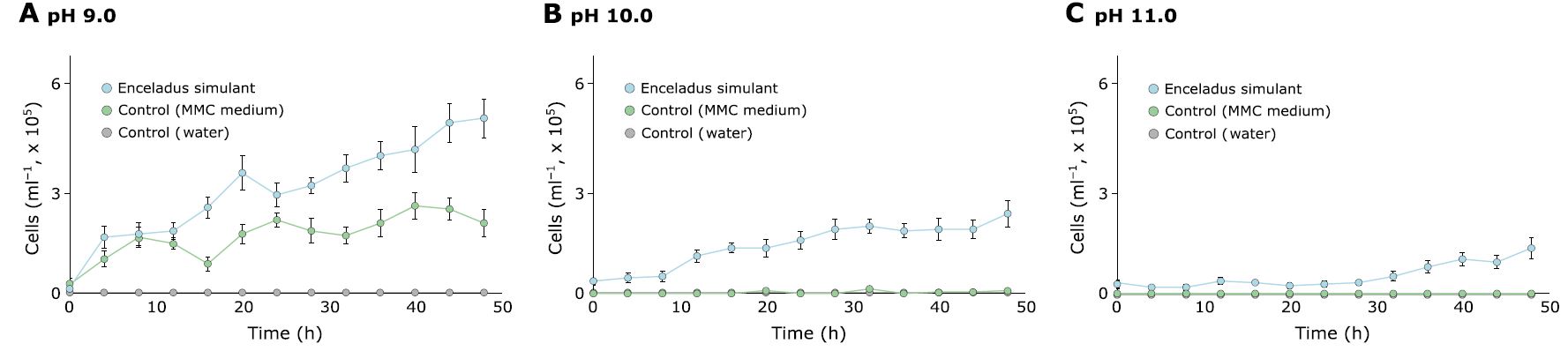
Figure 3 (click to enlarge). Cell growth in the 3 experimental alkaline conditions. Cell growth compared to the standard MMC culture for the organism and the sterile control. At pH greater than 9, only the simulated Enceladan ocean sample inoculum increased growth, while the MMC control showed no growth.
First, despite the low CO2 in the EOS, the microorganism extracted energy from the available H2 and CO2, as shown by the growth curves of the archean organisms over the 2-day experiment. A readout of their gene activity as RNA transcripts indicated that the organism over-expressed the genes in the acetyl-CoA pathway to reduce CO2 for fixation.
The methanogenesis reaction is an anaerobic respiration: CO2 + 4 H2 → CH4 + 2 H2O + energy
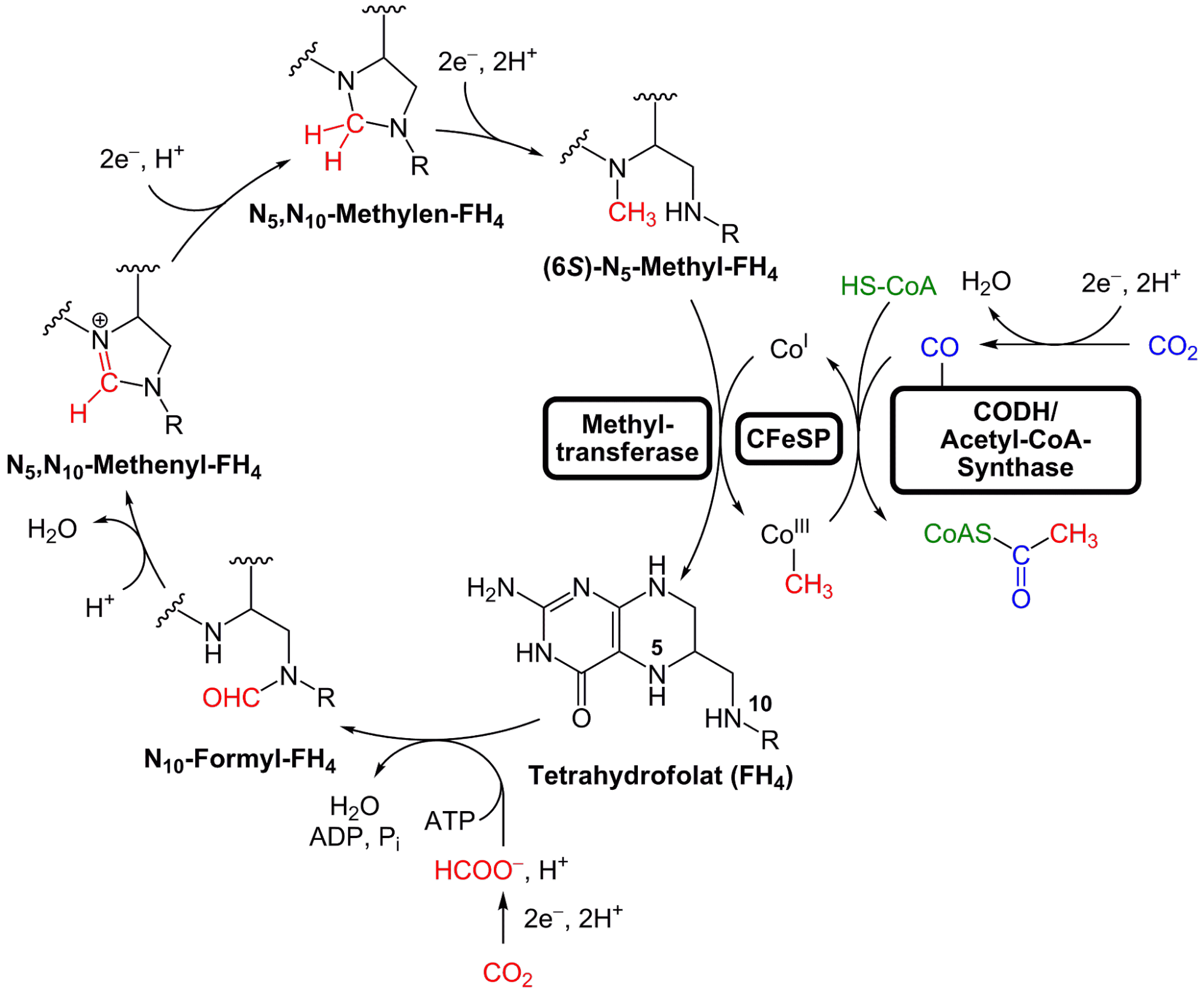
Figure 4 (click to enlarge). Reductive acetyl-CoA pathway in bacteria. CFeSP is a corrinoid iron-sulfur protein. The cyclic pathway consumes H2 and CO2 to fix carbon as acetyl-CoA, which is passed to other metabolic pathways for growth. – source: Wikipedia CC
To confirm that metabolism was occurring, the carbon source (sodium bicarbonate (NaHCO3), the source of CO2) was labelled with carbon-13 as a tracer. This tracer was detected in the released CH4, proving that the organism was responsible for the methanogenesis. [This type of labelled experiment was used to try to detect life with the Viking Mars landers in the 1970s.]
13CO2 + 4 H2 → 13CH4 + 2 H2O (the labeled carbon is transferred to the methane)
Second, the organisms were able to grow despite the alkalinity of the growth medium being beyond the range they were known to tolerate and survive. This adaptation seems to have been achieved by upregulation of the genes in the acetyl-CoA pathway. The experiment clearly demonstrates that a terrestrial organism could live at the hot vents at the bottom of the Enceladan ocean, at least as regards the experimental conditions allowed. While the experiment was not done at the pressure of their natural habitat, and that being greater than at the bottom of the Enceladan ocean, it seems unlikely that pressure was a constraint for such organisms.
The organisms would double their cell numbers about every 6 hours at the baseline conditions at pH 6.5 in MMC. Prior experiments had confirmed that these microbes could not survive in a terrestrial ocean above pH 8.5. At pH 9 in MMC, the growth rate was reduced, doubling in about 40 hours. By pH 10, the cells died. In the EOS condition, at pH 9 the cells doubled in about 23 hours, at pH 10 doubling in about 42 hours, and at pH 11 doubling was slowed to a calculated 126 hours. Although the growth rate was diminished as the pH was increased all the way to 11, the organisms were able to grow at the highest pH, which was well beyond the pH of their natural terrestrial habitat.
What this experiment proved was that a terrestrial organism, not adapted to Enceladus, was able to survive and grow if introduced to Enceladus around a hot vent, near the base of a plume, with an available heat source in the somewhat soda-like conditions of the ocean.
This is very significant, as it supports the earlier Cassini findings that the organic material extracted from the plumes could conceivably have come from organisms as well as an abiotic source. This doesn’t prove Enceladus has life, but that life can exist on Enceladus in the hot, dark conditions around vents at the rock-water interface, and would be worth searching for in a future mission.
It is worth noting that if these terrestrial microbes were introduced to a hot vent on Enceladus, the replication rate would fill that niche quickly due to the power of exponential growth.
Assuming that once that local niche was filled, further growth would be linear, as the new cells would be pushed out into the cold, near-freezing ocean in the plume. The cell density would be substantially reduced, but still detectable in the plume if intact. If the cells were destroyed as they froze, we might be able to detect cell fragments with sufficiently large collection volumes.
What would be exciting would be to detect biomolecules such as fragments of DNA, RNA, proteins, carbohydrates, or lipids in a sample. This could inform us whether any organisms were from a separate genesis, or from an introduction common to terrestrial organisms. Neither DNA, RNA, nor proteins were extracted from the Cassini plume analysis. Had there been, that would have been an unambiguous biosignature. We await a future mission to Enceladus, perhaps even a lander, to investigate further.
The paper about the Cassini plume analysis is: Khawaja, N., Postberg, F., O’Sullivan, T.R. et al. Detection of organic compounds in freshly ejected ice grains from Enceladus’s ocean. Nat Astron 9, 1662–1671 (2025). https://doi.org/10.1038/s41550-025-02655-y
The Experiment growing the methanogens in simulated Enceladan ocean water is: Helmbrecht, V., Postberg, F., Khawaja, N., Reichelt, R., Klein, F., Grohmann, D., & Orsi, W. D. (2026b). Enceladus-like geochemistry fuels methanogenesis under extreme CO 2 limitation. Science Advances, 12(39), eaei0167. https://doi.org/10.1126/sciadv.aei0167
References
1. Ocean vent. (n.d.). https://education.nationalgeographic.org/resource/ocean-vent/
2. Glein, C. R., Baross, J. A., & Waite, J. H. (2015). The pH of Enceladus’ ocean. Geochimica Et Cosmochimica Acta, 162, 202–219. https://doi.org/10.1016/j.gca.2015.04.017
Thoughts on Brown Dwarfs, Science Fiction and New Telescopes
Here’s an interesting notion, courtesy of science fiction writer Jack McDevitt. Jack’s story “Lighthouse” (available in Cryptic: The Best Short Fiction of Jack McDevitt (Subterranean Press, 2009) posits an apparently normal brown dwarf that, upon closer study, turns out to be deeply anomalous, in ways that seem designed to call attention to it. There appears to be no intent to establish contact but rather to warn anyone traveling near the object that there is a solitary black hole, all but undetectable, in its immediate vicinity.
And there is not just one brown dwarf, but several thousand that display similar anomalies in their spectra, as determined by a survey of these stars throughout the galaxy. Could these markers be a warning system for interstellar travelers? Written with Michael Shara, the story is a nice, compact bit of hard science fiction, working with realistic spectroscopic analysis and ingenious speculation. It’s also realistic about the kind of non-scientific pressures astronomers can face. Here the characters are wrangling over the unusual role deuterium plays in the spectra as they try to make sense of what they are seeing:
“I don’t buy it, Kristi,” Greg said. She had him on the vid relay, from his office. “There’s got to be a natural mechanism at work. Maybe high pressure chemistry. Maybe magnetic fields. Maybe radiative levitation. Geochemical processes can concentrate minerals by orders of magnitude on Earth, so why not deuterium on the surfaces of brown dwarfs under far more exotic conditions?”
He sounded really concerned. It was why she liked him so much. He was worried about what would happen to her career if she tried to go public with her notion. She imagined it was hard for him not to say, You’re skating at the edge of academic disaster. Blow your reputation now and you’ll always be at the fringe.
I like that bit. It wasn’t so long ago that writing about starships in a scientific journal was unusual, but these days we have many theorists pushing propulsion concepts and speculating on Fermi questions. Anyway, I notice that Jack’s story “Cool Neighbor” is freely available online. It’s another look at a brown dwarf, this one close indeed, and it reminds me of my own certainty that we would find a dim object like this within a light year or less. Alas, it was not to be, as the WISE data made clear, but we did find a lot of interesting objects, including Luhman 16 whose members are the closest brown dwarfs in the inventory.
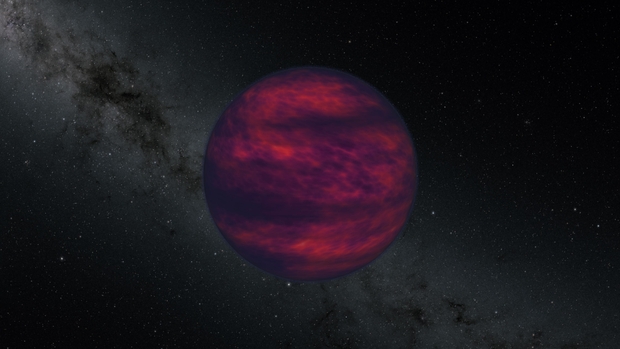
Image: Untold numbers of brown dwarfs roam the cosmos, like the one in this artist’s concept. But only a few dozen have been studied in detail with space-based telescopes. With the help of NASA’s SPHEREx, scientists are in the process of analyzing thousands more. Credit: NASA/JPL-Caltech.
Luhman 16 B, is to my knowledge the first brown dwarf to have its weather mapped, which fits nicely with the recent news about WISE 0855, a brown dwarf not all that much further away than Luhman 16 at 7.5 light years. In the just released study, WISE 0855 is subjected to atmospheric analysis that shows water clouds changing in thickness as the time series work proceeds. Brittany Miles (Steward Observatory, University of Arizona, Tucson) took spectra of the object every 15 minutes for 11 hours, to reveal not just the movement in the water clouds but processes of deep convection bringing up gases from below.,
We have JWST to thank for the find, as Miles notes:
“This is the first time we’ve been able to confirm that water clouds are becoming thinner and thicker on a nearby world. Before JWST, we only had photometry, which mixed up the effects of clouds, chemistry, and temperature all together. Now we can actually distinguish them.”
WISE 0855 is hard to distinguish from a free-floating planet, given that its effective temperature (265 K) is not all that much warmer than Earth’s. Churning carbon monoxide and phosphine are what is currently identified in the data as rising from below thanks to the heat within the object. The same process of convective churn is seen on Jupiter and is tracked on this brown dwarf with the greatest clarity yet, a molecule-by-molecule variation seen in real time. WISE 0855 doesn’t look like Jupiter but it displays similar weather patterns.
Brown dwarfs are ubiquitous these days, but I still remember the announcement of Teide 1. This object, in the Pleiades cluster, turned up in data from the IAC-80 telescope in Tenerife (Canary Islands), with the paper published in 1995 in Nature. Shortly followed by Gliese 229B, the object launched the study of remarkably low temperature stars, now classified in ways that sometimes muddle the distinction between planet and star. How far we’ve come since then. Have a look at the just released image from SPHEREx, which is only a partial look at the thousands of brown dwarfs that are being identified.
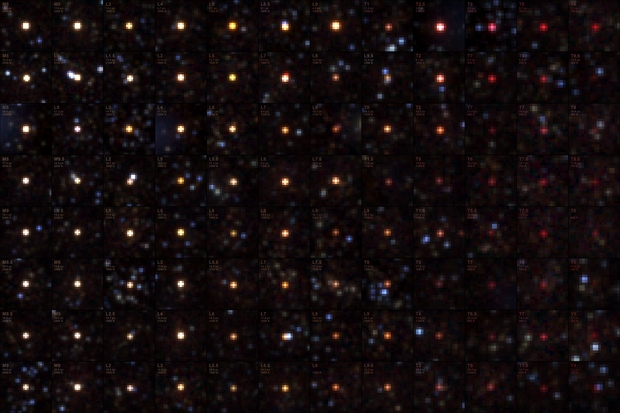
Image: As it maps the sky, NASA’s SPHEREx telescope is finding thousands of brown dwarfs hiding in the dark. A selection is shown in this collage of observations, listed by spectral type, distance, and temperature in degrees Kelvin. Credit: Zafar Rustamkulov/NASA/JPL-Caltech.
SPHEREx (Spectro-Photometer for the History of the Universe, Epoch of Reionization, and Ices Explorer) is making the case that brown dwarfs have a range of atmospheres rich in chemistry that show striking similarities to gas giants. The image above is drawn from SPHEREx infrared observations of 37 nearby brown dwarfs with a wide range of temperatures, from 2200 degrees Celsius (2477 K) to -20 degrees Celsius (253 K). Water, carbon dioxide, carbon monoxide and methane turn up in the analysis of their atmospheres.
Launched in March of 2025, SPHEREx is engaged in mapping the entire sky in near-infrared light, taking on the order of 3600 images per day. The instrument is multi-purpose, its major goal being to study the distribution of galaxies in the distant universe. But the brown dwarf component makes it possible to observe atmospheric chemistry across a wide range of temperatures in these objects. Although the paper deals with a relatively small number, thousands more brown dwarfs are now being analyzed. Lead author Zafar Rustamkulov (Caltech) adds:
“From orbit, SPHEREx sees wavelengths of light that are basically impossible to see with telescopes on the ground because water in Earth’s atmosphere absorbs them. We are picking up light from the deep, red clouds of brown dwarfs all over the sky.”
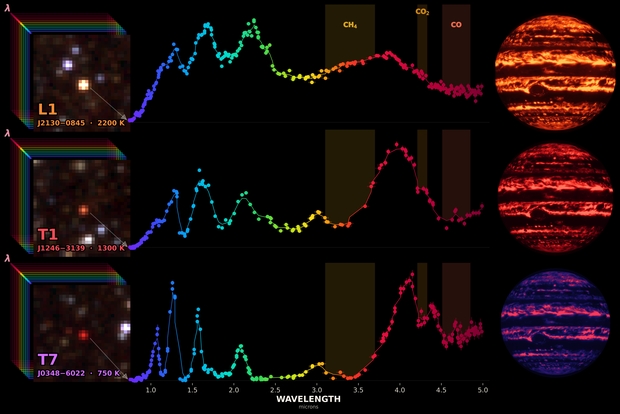
Image: Thanks to its spectral coverage, NASA’s SPHEREx is revealing molecules like methane (CH4), carbon dioxide (CO2), and carbon monoxide (CO) in brown dwarf atmospheres. The telescope’s view of three different brown dwarfs appears on the left; the depictions on the right imagine them as Jupiter-like worlds. Credit: Zafar Rustamkulov/International Gemini Observatory / NOIRLab / NSF/ AURA, M.H. Wong (UC Berkeley) et al. Acknowledgements: M. Zamani.
Rustamkulov also notes how the absorption patterns in these spectra change as brown dwarfs age and grow cooler, with some of the objects in the SPHEREx data showing thinning clouds and increasingly methane-rich atmospheres. He adds:
“The state-of-the-art models are capturing the general chemical trend, but when it comes to these cloudy transitions, the models are struggling to match the data. No two brown dwarfs are alike. Even at the same temperature, their spectra look quite distinct.”
Indeed. The paper comments that “state-of-the-art brown dwarf model grids generally fail to trace their complex features.” So exactly where are we right now? From the paper:
…the models generally approximate the smoothly coherent abundance trends of CO and CO2 as they are converted to CH4 with declining temperature and increasing age. We also show that the addition of clouds does not improve Diamondback model fits (see Figures 14 and 15), especially at the cloudy L/T transition (see Figure 7), implying the need for more theoretical work connecting clouds with chemistry. Optimistically, the models seem to qualitatively represent the low-gravity and low-metallicity L dwarfs (see Figures A2, A3, A4, and A5, which probe a more extreme regime of parameter space.
So we’re beginning to unlock some of the secrets of brown dwarf atmospheric chemistry, but as you would expect, our existing models need to be tuned up in this new era of rapidly multiplying observational data. I’m reminded by the last several posts here that any graduate student looking for abundant challenges might want to consider dwarf possibilities, from white to brown, as both categories are yielding data we are only now able to explore. The exoplanet landscape around these objects is particularly frothy with potential.
The paper on WISE 0855 is Miles, et al., “Water Cloud and Chemical Modulations in the Coldest Brown Dwarf,” accepted at The Astronomical Journal (preprint). The SPHEREx paper is Rustamkulov et al., “SPHEREx 0.75–5 μm Spectra for a Sequence of Nearby Brown Dwarfs,” The Astrophysical Journal Vol. 1009, No. 2 (28 September 2026). Full text.
Musings on White Dwarfs and Planetary Survival
A research team at the University of Warwick (UK) has turned up what may be a planet orbiting a white dwarf. That’s an interesting find given the lifetime of white dwarfs after the parent star has lost its outer envelope. Any life on such a world would have several billion years to work with (see White Dwarfs and Habitable Planets for more), although this planet is far too young for that. But this find has other implications. If confirmed, it would be the first planet thought to have formed through accretion of materials left over from the death of the red giant. It would be evidence of a second generation, a planet-hosting period that begins after the red giant phase is over.
The star is HS 0209+0832, a young and hot white dwarf maybe five million years beyond the red giant phase. The original discovery came in 1999 by way of the Hubble Space Telescope, although the data had remained little studied in the archives since then. It took examination by doctoral candidate Jamie Williams at Warwick to explain some of the unusual chemical signatures lurking in the data. Over 100 chemical features from the initial Hubble observations needed clarification, and Williams discovered that a primary player was niobium.
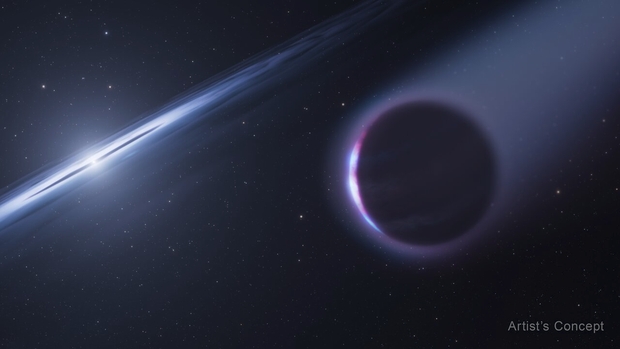
Image: This artist’s concept depicts a possible explanation for the unusual chemical abundances the NASA/ESA Hubble Space Telescope detected in the HS 0209+0832 system: a second-generation planet orbiting the white dwarf star. The white dwarf is the “dead” core of a star that burned through all of its nuclear fuel and lost its outer envelope of gas and dust to space. The second-generation planet formed from that cast-off gas and dust, which is why its chemical content is very different from a planet that formed as its host star was forming. Credit: NASA, ESA, L. Hustak (STScI).
This is interesting not only because of the idea of planet formation in a kind of ‘rebirth’ of a planetary system, but also because it opens up new lines of research. Here’s Williams, who is now lead author of a paper on this work:
“Rather than the white dwarf stage being a kind of epilogue to the story of a star and its planets, this research points to the systems we are familiar with only being the first chapter of a potentially much longer tale, with some new characters showing up. That’s a really exciting prospect to pursue. What Hubble is showing us in this white dwarf system is something we haven’t seen before: a high abundance of the element niobium, the signature of which I was unfamiliar with when I first found it in the archival data.”
To clarify what was going on in this unusual system required that Williams and team study not just the Hubble data but also that of further observations from the Far Ultraviolet Spectroscopic Explorer mission (FUSE), launched in 1999, the latter confirming the presence of niobium in the spectrum. Interestingly, the team looked at 33 other white dwarfs with signs of metal pollution in their atmospheres and found none with niobium. Further observations with TESS (Transiting Exoplanet Survey Satellite) showed periodic brightness variations consistent with a planet orbiting at approximately 6 million kilometers.
The niobium signature is critical because it is an element that is not formed in a stellar core through fusion. “Instead,” says co-author Nicholas Stone (University of Wisconsin – Madison) “these heavy elements can only be synthesised in the exotic conditions that briefly emerge inside dying stars. The presence of niobium is a signpost of these ‘death’ throes, and the expulsion of the dying star’s innards into space.”
The supposition is that material ejected from the dying star, enriched by exotic chemistry, coalesced into what appears to be a gas giant. The team argues that it is likely the size of Jupiter, and probably losing atmosphere given that the white dwarf would be stripping its outer material in such a tight orbit. Says Williams: “If the second-generation planet is there, I think it is likely to survive. Eventually the white dwarf will cool and then maintain a consistent temperature, with the planet in its stable habitable zone for millions of years.”
But forming this kind of disk is itself tricky. If planets like this are as rare as they seem, that may be because forming them requires another companion that helps to shepherd the ejected material from the dying star into orbit, rather than simply shedding it into interstellar space. For that, let’s look at the paper:
Assuming spherically symmetric mass loss, a second-generation proto-planetary disc is unlikely to form around a single AGB star, but there are several mechanisms that can lead to a disc if a binary companion was present. Evidence for the formation of such a disc has been found at the post-common envelope binary NN Ser as well as several post-AGB binaries. In particular, a close-in low-mass companion to the progenitor of HS 0209+0832 would have entered a common envelope event during the AGB phase, resulting in the ejection of the envelope and the formation of a circumstellar disc rich in s-process elements. A second-generation giant planet could have formed within that disc via direct gravitational collapse close to the white dwarf. Alternatively, a first-generation sub-Neptune or super-Earth that was scattered towards the second-generation proto-planetary disc could have accreted a second-generation atmosphere around a first-generation core.
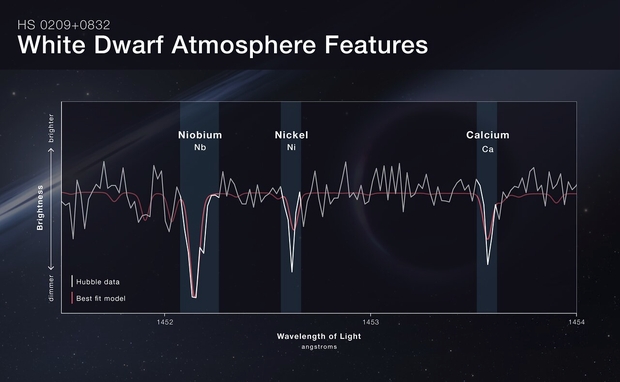
Image: This NASA/ESA Hubble Space Telescope spectrum shows the unusual abundances of certain elements it found in the HS 0209+0832 system. Dips indicate where niobium, nickel, and calcium are absorbing light, so less light in that part of the spectrum reached Hubble. The reason the starlight is showing elements that astronomers attribute to a planet has to do with interactions between the white dwarf star and planet. The white dwarf is still hot and is blasting the planet with radiation, causing it to lose atmosphere to space. That atmospheric material is flowing back toward the white dwarf, forming a disk and then falling back onto its surface. Credit: NASA, ESA, L. Hustak (STScI).
So while we can speculate about the fate of the inner planets in our Solar System when our Sun goes through its red giant phase, we may have to add in a scenario where a new inner system forms around a hot white dwarf with a long lifetime of its own. That’s assuming a mechanism that supports planet formation there. A still viable Jupiter using its formidable mass to shape a growing circumstellar cloud/disk? The example of HS 0209+0832 makes this at least plausible, although again, we have no good idea of how often such processes produce new planets.
White dwarfs will continue to energize research. From an exoplanet standpoint, imagine an Earth-size planet in transit across a white dwarf. That would be a transit signature for the ages. From the astrobiological perspective, consider that a white dwarf gradually loses heat because it has no fuel. This is a process, however, that can take several billion years before the star’s surface cools to the Sun’s current temperatures. Even that long life-time is eclipsed by the star’s eventual death as a ‘black dwarf,’ an inert object of a sort never observed because to reach that state would take longer than the age of the universe.
The paper is Williams et al., “Discovery of a second-generation planet candidate accreting onto a white dwarf,” Nature Astronomy 5 October 2026 (full text).
Photosynthesis: A New Angle into Fermi’s Paradox?
One of the things that gives the Fermi paradox its punch is the age of the galaxy. Back in 1950 when Fermi uttered his famous ‘Where is everybody?’ question, ideas about how old the Milky Way was were all over the map. Working with Hubble’s constant as understood at the time, the entire universe looked to be no more than 2 billion years old, a problem given what we were learning about the age of the Earth itself based on radioactive dating. So workarounds were needed, and they included the then widely supported steady-state theory, which saw a universe without beginning or end.
Then too, the problem of the age of the galaxy could not be satisfactorily worked out because we had no good methods to gauge the age of individual stars. A book could be written about the evolution of our thinking on both age problems, but for now, let’s say that Fermi asked his question about extraterrestrials at a time when values for the age of the galaxy were generally set at between 3 and 5 billion years. The tension between this and the Hubble constant values would persist, although Allan Sandage managed by the end of the 1950s to come up with an estimate for the universe of 13 billion years.
Fermi’s question gets more acute every time we come up with new information about how old our system is compared to the age of the galaxy. As we’ve discussed in these pages many times before, Charles Lineweaver’s work early in the 21st century demonstrated that we are newcomers compared to at least some of the stars in our vicinity. If that’s the case, then the idea of habitable planets being in existence several billion years before we showed up is plausible. And if we take ourselves as the measure (always dangerous, but we are the only datapoint), the idea of advanced extraterrestrial civilisations seems likely, assuming that these could find ways to avoid destroying themselves.
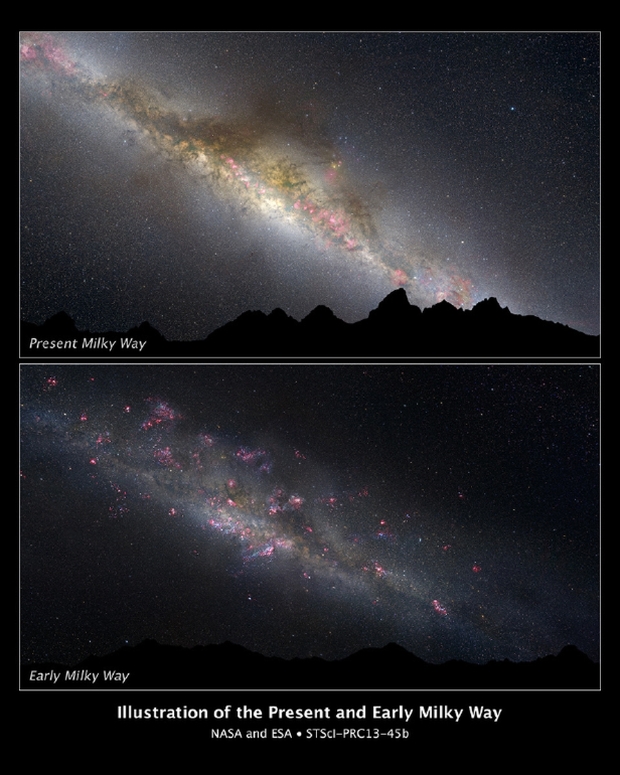
Image: The galaxy evolves. How many stars of the 400 billion now thought to exist here emerged at least a billion years before the Sun coalesced?
As always, though, we have to scout our assumptions. Just because it took what we now believe to be 4.6 billion years for Earth to produce intelligent life, why should that be the case everywhere else? An interesting new paper takes on that question by suggesting that no matter the size of their headstart, planets much older than our own may still be in the early stages of microbial life, without yet reaching the point of producing even primitive larger species.
The work of Chris Doughty (Northern Arizona University) and colleagues, the paper argues that we should be looking at what the team calls ‘plant energy,’ and stop focusing on time as an indicator of likely development. The hypothesis: “The biological evolution rate is a linear function of cumulative carbon fixed on a planet.” Note the word ‘fixed.’ What this describes is the process of taking carbon dioxide, an inorganic gas, and turning it into organic molecules like sugars. Photosynthesis does most of this work on Earth. It uses the energy derived from sunlight as the driver, with the carbon taken out of the atmosphere and oceans and put to use in biological systems.
Proposing a linear link between the amount of carbon fixed in this way and the rate of evolutionary development is a striking move. It’s even more so when considered as a tool for exoplanet research. The paper looks at the amount of carbon Earth has fixed over its lifetime and compares that to what other planets are likely to have fixed during their own lifetimes. 29 exoplanets are studied here, with only two of them surpassing Earth’s cumulative Net Primary Production (NPP), and therefore capable of developing multicellular and perhaps intelligent life. NPP refers to the carbon fixed by photosynthesis that ends up as new biomass.
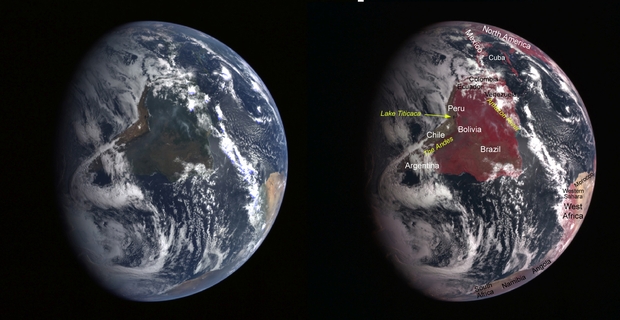
Image: How we see plant photosynthetic pigments. The MESSENGER image of Earth on the left is very close to what can be seen by the human eye. For the image on the right, a red component was substituted that shows near infra-red colors. The vegetation in the Amazon basin produces the purplish-red color in the center of the image. The new paper proposes that cumulative fixed carbon is itself a marker that can be tied not only to life but to the pace of evolutionary change. (Image credit: NASA/Johns Hopkins University Applied Physics Laboratory/Carnegie Institution of Washington, via JPL Photojournal).
The planets on Doughty’s list are chosen from the Habitable Worlds Catalog, which organizes NASA data based on factors such as radius, irradiation, temperature and age. The authors use stellar radiation, temperature and precipitation maps from several recent studies to calculate how Earth fixed carbon in different stages of biological evolution, and ask how long the examined planets would take to achieve the same amount of carbon.
From the paper:
Assuming Darwinian evolution, a baseline astrobiological assumption… each generation of life has a small potential for genetic change following either sexual or asexual reproduction. These genetic changes will either be successful or not depending on the environment, species competition or predation around the organism. We therefore hypothesize that Earth’s cumulative carbon fixed at certain periods has led to major evolutionary transitions such as the emergence of photosynthetic organisms, eukaryote and multicellular animals that fundamentally altered the Earth’s carbon cycle, accelerating it at certain points.
So we can think of the accumulated plant energy of an entire planet and acknowledge that planets with more plant growth as mediated by photosynthesis will tend to be warmer, wetter places than average. This gets interesting when we think about red dwarf planets, especially since these have enormous lifetimes and many are several billion years older than Earth. The authors make the case that these time factors provide no necessary advantage.
What counts is that life on a planet like TRAPPIST-1e, one of those studied here, would have lower rates of total photosynthesis because the surface receives correspondingly less light. Moreover, tidal lock on M-dwarf habitable planets would mean losing half their surface for photosynthesis. In this study, TRAPPIST-1e is found to have the capability of fixing no more than 21 percent of Earth’s carbon. An older world, but perhaps one with nothing more than microbial life.
We have interesting simulations of places like TRAPPIST-1e, climate maps that allow us to estimate how long it would take other planets to achieve the same amount of carbon fixed as we find on Earth. Of the 29 worlds considered potentially habitable by the authors, 27 are in fact orbiting red dwarf stars, and presumably tidally locked. Net Primary Production is calculated for each. The results are heavily weighted toward life at no more than microbial level:
If the biological evolutionary state is a function of cumulative carbon fixed and life began on each of the 29 exoplanets like it had on Earth, life on most of those 29 exoplanets would most likely be evolutionarily behind Earth (with two exceptions discussed below). The majority of our simulations led to most planets at the predicted microbial life stage with the exception of simulations using climates with 1 bar CO2. These very warm, wet planets accelerated NPP production which led about a third of the planets potentially ahead of Earth.
That sounds rather promising, but read on:
However, recent JWST observations showed no evidence of a thick carbon dioxide atmosphere on TRAPPIST-1c… or TRAPPIST-1e… therefore 1 bar CO2 may be unlikely on potentially habitable exoplanets. This raises the question of whether life can exist on an exoplanet with 1 bar CO2 in the atmosphere. CO2 concentrations in the early Earth may have been as high as 10 bar and up to ∼4,000 ppm CO2 in the atmosphere in the Cambrian (Royer, Reference Royer 2006), but 1 bar CO2 might not be conducive to land-based life.
The uncertainties here abound, as the authors are quick to acknowledge. We do not, in fact, know whether any of these planets actually have atmospheres in the first place. Nor, obviously, do we have any idea of their composition if they do exist. We have no knowledge about the presence of carbon at the surface, and also have to factor in the possibility of biological processes modifying the composition of any atmosphere present, just as Earth’s atmosphere was gradually transformed as the effects of photosynthesis began to be felt.
For that matter, can we assume that the life we are looking for uses carbon along the lines of life on Earth? If it does, this study predicts that most stars in our stellar neighborhood, despite sometimes being much older than Earth, are behind our planet when it comes to biological evolution. Two planets – GJ 1061c and K2-3d – do stand out as being of unusual observational interest for present and future space telescopes. Both are both larger and older than Earth.
This is useful information, given that our first thorough analyses of planets of Earth mass are going to occur with planets orbiting low mass stars. When we reach the point of instruments like Habitable Worlds Observatory that can image planets around G-class stars, the discouraging catalog analyzed in this paper may be replaced with a more positive one. If Doughty and team are right, however, we have an answer to the Fermi paradox and the time problem. Intelligent life has far fewer places on which to develop than we thought.
The paper is Doughty et al, Calculating potential cumulative carbon fixed and evolutionary stage for Earthlike planets in our solar neighborhood, International Journal of Astrobiology (2026). Published online by Cambridge University Press 22 September 2026. Full text.
Sakurai’s Object: A Stellar Rebirth
Given how long stars live in comparison to human lifetimes, I always do a double-take at science fiction tales of starships dropping in to study a nova just as it’s about to go off. I suppose we have to assume the starship civilization has found a way to time such matters. There’s a Star Trek: The Next Generation episode that involves rescuing a planetary population from a star that’s about to explode (“A Fury Scorned”), but of all the nova arrivals, I like Samuel Delany’s 1968 novel Nova the best. Here, in order to harvest a rare element dubbed ‘Illyrion,’ the exact moment of the explosion has to be known and exploited through a mind-bending run through the debris.
Today’s paper doesn’t involve a nova, but it does involve a star that is doing things on a very short timeframe indeed. The star is known as Sakurai’s Object (V4334 Sagittarii). Japanese amateur Yukio Sakurai observed the object in 1996, noting how it appeared to be brightening. A 1976 detection of the progenitor star had recorded a magnitude of 21, whereas when Sakurai tagged it, it had reached magnitude 11. The apparent eruption here was first thought to be the result of a nova, but that was discounted for spectral reasons.
Several years later the unusual brightening began to decline. That was evidently the result of loss of mass and subsequent condensation of stellar material, which wound up hiding the star behind a dusty screen. It now shows a spectrum similar to what is known as a Wolf-Rayet star. Sakurai’s Object appears, however, to be in the much less massive Wolf-Rayet class known as a [WR] star. A conventional Wolf-Rayet star is massive, stripped of its hydrogen by huge stellar winds that leave the underlying helium-burning layers exposed. The odd [WR] notation turns out to be needed because low-mass objects like these can mimic a Wolf-Rayet star, so it was necessary to show that this is a different kind of object and a much smaller kind at that, though with Wolf-Rayet features.
There are also sub-categories of [WR] including [WC] that don’t need to occupy us now, although the paper explains what they mean. What’s intriguing about Sakurai’s object is its pace. According to current calculations it’s now roughly 6 times hotter than it was 30 years ago, and is climbing back toward the white dwarf temperatures it had before the eruption that made it observable by Sakurai. Albert Zijlstra (Jodrell Bank Centre for Astrophysics, University of Manchester), describes its significance:
“Most stars evolve so slowly that major changes take place over timescales far longer than a human lifetime. As a result, we usually have to piece together snapshots of stellar evolution by comparing different stars at different stages of their lives. Sakurai’s Object offers something far rarer. It is one of the very few stars known to have changed dramatically within just a few decades, giving us the opportunity to watch stellar evolution unfold in real time. With our observations, we can test theories of how stars evolve and gain new insights into one of the shortest and least understood phases in the life of a dying star.”
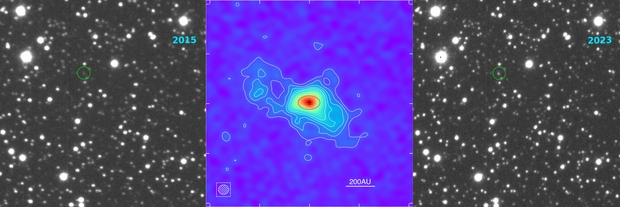
Image: The rapid brightening of Sakurai’s object allows astronomers to study the final phases of the stellar evolution in only a few decades. The left and right panels show the brightening. The middle panel is an image obtained with the radio telescope ALMA, showing the material ejected after the star re-ignited. The material currently extends over a size similar to our entire solar system. Credit: Stefan Kimeswenger, University of Innsbruck; Peter van Hoof, Royal Observatory Belgium. The observatory also has a short video showing the brightening.
What we apparently have here is a star once similar to the Sun that had finished its nuclear burning and was in the process of turning into a dense white dwarf star about the size of the Earth. But an event known as a ‘very late thermal pulse’ seems to have occurred. This happens when helium deep inside the star reignites, forcing a rapid expansion along with the ejection of stellar materials, so that the star has, at least for the time being, been reinvigorated. Along with another star called V605 Aquilae, Sakurai’s Object is one of only two stars that have been directly observed going through this process.
Let me turn to the paper to home in on the matter of thermal pulses:
Depending on when the pulse occurs, it is classified as an AGB final thermal pulse (AFTP), a late thermal pulse (LTP; post-AGB), or a very late thermal pulse (VLTP; see M. M. Miller Bertolami 2024). In the most extreme case (VLTP), the star is already on the white-dwarf cooling track when the flash causes rapid expansion and cooling, accompanied by substantial mass ejection into the circumstellar environment. The star is thus “born again” and returns close to its former AGB position in the HR diagram. Subsequent evolution involves reheating, and possibly an additional cooling excursion, as the star evolves back towards the white-dwarf domain with a markedly altered surface composition (T. M. Lawlor & J. MacDonald 2003).
No wonder this was a hard object to observe. The ejected gas and dust following the 1996 outburst caused the star to became hidden to direct imaging. Low density gases are coming off the star even as the outflowing atmosphere, moving at e 500 kilometers per second, is optically thick. Much of the spectrum produced is nebular. The team compared data from the VLT with computer models originally developed to study the processes that power the atmospheres and winds of Wolf-Rayet stars. The emission lines studied in this paper are embedded in the stellar wind, as opposed to the ejecta and dust. Much of the credibility of the analysis depends upon separating these factors.
The analysis reveals a stellar temperature at the surface pegged at between 27,000 and 36,000 degrees Kelvin. Scientists will now be able to study the process of the reheating following the eruption that occurred thirty years ago. Early indications are that the process is occurring more slowly than some models had predicted, so that Sakurai’s Object becomes a useful laboratory, like V605 Aquilae, into stellar behavior in this extremely rare class of stars. At some point, Sakurai’s Object will return to its fate as a white dwarf, only now under close observation as we ponder massive changes in a very short order.
Griet Van de Steene (Royal Observatory of Belgium), a co-author of the paper adds:
“Sakurai’s Object evolved much more quickly than pre-existing models for stellar evolution predicted. This led to a new generation of models that we now need to test. Our measurements show that the star is reheating more gradually than some of these new models predicted. That gives us an important way of testing which theories best describe what happens when a dying star briefly springs back to life. As we continue to monitor the star over the coming years, we expect to learn much more about this remarkable phase of stellar evolution.”
The paper is Marcolino et al (2026). The emergence of a [WC] star in Sakurai’s object. Monthly Notices of the Royal Astronomical Society, 552(1), Article stag1533. Full text.
Disrupted Systems: Implications for Life
Anthropocentric thinking is a persistent problem when we’re talking about extraterrestrial civilizations. Some of our most cherished notions can be invoked so effortlessly as to defy the imagination. The Copernican idea that life must exist elsewhere because elsewhere is bound to be more or less like here has had a long lifetime in SETI studies. It seems like the most basic common sense. And yet, as we’ll see once again today, scientific results continue to make it apparent that the fact that we are here does not mean that they are there.
Finding stellar systems more or less like our own continues to be difficult. I’m not going full ‘rare Earth’ here but acknowledging that our circumstances may be unusual enough to tamp down estimates of the number of life-supporting planets. For that matter, our lack of knowledge about abiogenesis itself makes the case that we cannot necessarily expect it around other suns. On this matter, at least, we should be able to gather data soon, perhaps with a Mars lander.
Which gets me to today’s interesting take on binary stars. The binaries – HD 129171 and HD 129209 – are G-class, both having formed from the same molecular cloud. This is a common enough scenario, because binary systems are extremely common. In fact, about half of the stars in the Milky Way have a companion star, and thus are likely to share a common chemistry.
About 180 light years from the Sun (based on Gaia data) in Boötes, the system is proving unusually helpful. Using the UVES spectrograph on ESO’s Very Large Telescope (VLT) in Chile, an international effort led by Anne Rathsam at the University of São Paulo in Brazil is using this binary as a laboratory to study chemical differences between the stars that may be telling us something about planet formation and orbital evolution. What is driving the differences?
All this has a bearing on life, because for life to occur, conditions must exist for long enough to let the necessary processes go to work. And that may be a problem. HD 129171 turns out to be enriched in refractory elements, while its companion HD 129209 is not. Refractory elements condense at high temperatures, as opposed to volatiles, and the proportion of one to the other can be an interesting diagnostic tool, telling us something about the system’s history. A star depleted in refractories is likely one that has spawned planets, while one heavy in these elements has likely swallowed planets whole.
Rathsam’s work, available in a paper just published in Astronomy & Astrophysics, focuses on beryllium, whose abundance here is interesting because it is not produced in stellar interiors. Measured properly, its presence points to a star that consumed planetary material long after formation. Lithium, beryllium, and boron, in fact, share characteristics that make them exceptional in terms of chemical emergence in the galaxy. Jorge Luis Melendez Moreno (USP), who served as study advisor to Rathsam on this paper, explains:
“All other chemical elements originate from primordial nucleosynthesis [the formation of the first atomic nuclei in the minutes following the Big Bang] or stellar nucleosynthesis [the nuclear fusion process that occurs inside stars throughout their lifetimes]. But not beryllium and boron. They primarily arise through a process called ‘cosmic spallation,’ in which high-energy particles fragment heavier nuclei, such as carbon, nitrogen, and oxygen, producing lighter elements.”
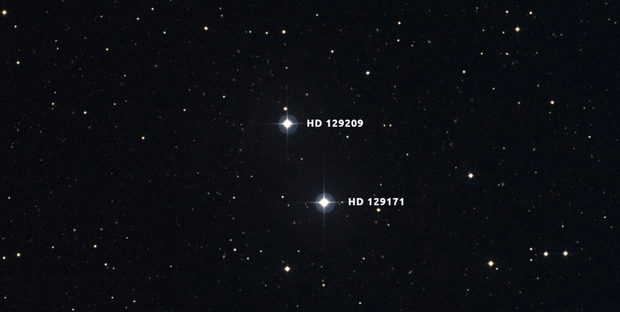
Image: The binary system of HD 129171 and HD 129209. Credit: Digital Sky Survey/Aladin/Anne Rathsam.
Lithium has its own uses as a marker, but the USP researchers found that beryllium is the more reliable tool, with a longer lasting chemical signature. HD 129171’s surplus of refractory elements (including magnesium, silicon, calcium and titanium) compared to its companion HD 129209 is accompanied by lithium and beryllium excess as well. The authors see evidence for rocky material equivalent to more than eleven times the mass of the Earth. This would have been ingested in the star, raising interesting questions about planet dynamics.
The infall of entire planets into a host star can be explained in various ways, from gravitational perturbations from other planets on eccentric orbits or skewed inclinations, to interactions within the early circumstellar disk driving young planets onto migratory trajectories. Although I hadn’t seen this paper before, the authors cite a 2025 study by Soares and team (citation below) that draws on simulations to show that about half of the stars simulated should ingest planets, leaving a chemical signature in perhaps 20 percent of them.
Evidently we can imagine system disruptions as a common occurrence in the Milky Way. We might add to this the fact that planet configurations with giant planets in circular outer orbits and rocky planets on inner ones are not common. Our observational data so far tends to confirm this, although tracking outer Jupiter-class planets with our current detection methods is always problematic given their sparse transit signatures. Overall, though, the picture that is emerging is that systems similar to the Solar System seem rare. If many systems are going through upheavals through planet migration and ingestion into the host, stable orbits may be trickier than we’ve thought. Rathsam comments:
“In our planetary system, the planets have relatively stable, low-eccentricity orbits. However, if planetary engulfment is common, it suggests that many systems undergo violent dynamic phases.”
Implications?
“Life wouldn’t just need billions of years to emerge and evolve. The planet would also have to remain in a sufficiently stable orbit to survive significant gravitational perturbations.”
If you’re wondering about our own star, it’s light in refractory materials relative to volatiles, which at least one recent study sees as a sign of planet formation at an early era. What became rocky planets and planetesimals, in other words, was never accreted into our star. I give that citation below. This and subsequent work seems to peg the Sun as the center of a dynamically quiet system compared to many, but be aware that the debate on this matter continues.
How useful is beryllium as a marker in such an analysis? The authors argue that despite the fact that beryllium is eventually depleted in a stellar interior, it persists long enough to provide reliable information. From the paper (my italics):
Refractory elements offer an excellent way to distinguish between the planet engulfment or the proto-cloud inhomogeneity scenarios. Since they have high condensation temperatures (≳1000 K), they are the primary constituents of the rocky material in planetary systems – terrestrial planets and cores of gaseous planets. In case of engulfment by a Sun-like star, this material is accreted by the star and then dissolved and mixed in the convective envelope, increasing the stellar surface abundances after the event (Sandquist et al. 2002). This process, however, produces a metal-rich outer layer with an unstable mean molecular weight gradient, which triggers thermohaline mixing (Théado & Vauclair 2012; Sevilla et al. 2022). For fragile elements such as Li and Be, this thermohaline mixing induces depletion, as it can carry these elements below the convective zone, into their burning regions. Thus, the chemical enrichment caused by the engulfment disappears over time. Nevertheless, Sevilla et al. (2022) demonstrated through simulations that the Li engulfment signature in stars with masses close to solar can be detected for ≥1 Gyr.
As far as I can tell, it’s the treatment of beryllium as a marker of engulfment that gives this paper its significance, as heretofore it has been used primarily as a diagnostic for the mixing of elements in stellar interiors. More broadly speaking, though, any reminders of the factors that make our Solar System adaptable for life should help us in identifying systems where life is less likely. That’s worth keeping in mind as we move beyond easy assumptions about life’s ubiquity and dig into realities that may make it more unusual than we thought.
The paper is Rathsam et al. (2026). Planet engulfment in the chemically anomalous HD 129171/HD 129209 pair. Astronomy & Astrophysics, 710, A236 (full text). The interesting paper on beryllium’s persistence is Soares et al. (2025). Assessing the processes behind planet engulfment and its imprints. Astronomy & Astrophysics, 693, A47 (preprint). The paper on the composition of our Sun is Meléndez et al. (2009). The peculiar solar composition and its possible relation to planet formation. The Astrophysical Journal Letters, 704(1), L66–L70. Abstract.