
In fact, gravity is some 1038 times weaker than the strong force that holds atomic nuclei together, easily illustrated by pointing out to my friend that I was overcoming an entire planet’s worth of gravity by lifting the salt shaker on the table. I learned from Greg Matloff and Eugene Mallove’s The Starflight Handbook that despite Freeman Dyson’s early interest in using the gravitational force to capture energy from astronomical objects, it was Stanislaw Ulam who first pondered the idea in print.

Now Ulam is an interesting figure, a name that resonates on Centauri Dreams in the context of nuclear pulse propulsion, which he first analyzed as far back as 1947 in a report for Los Alamos Scientific Laboratory. This grew into the Project Orion concept, with nuclear bombs exploded behind a flat steel plate, the crew protected by the mother of all shock absorbers. Ulam’s work on gravitational machines, however, analyzed how much energy could be extracted in a three-body system, one of which was a rocket, and what kind of velocities such a rocket could attain.
Image: Stanislaw Ulam (1909-1984), well known for his work on Orion, but also an early analyst of the extraction of gravitational energy.
Freeman Dyson’s notion, explained in the paper “Gravitational Machines” that we looked at last week, was to extract energy from a binary star system, as shown in the figure from the paper below. The ever imaginative Dyson, remember, was captivated by the possibilities of engineering on the part of advanced civilizations, whose works we might observe in the form of technosignatures. Here, the idea involves two stars of mass equal to the Sun revolving around a common barycenter. A spacecraft can be injected into an orbit that maximizes the gravitational effect, as Dyson explains:
The exploiters of the device are living on a planet or vehicle P which circles around the double star at a distance much greater than R. They propel a small mass C into an orbit which falls toward the double star, starting from P with a small velocity. The orbit of C is computed in such a way that it makes a close approach to B at a time when B is moving in a direction opposite to the direction of arrival of C. The mass C then swings around B and escapes with greatly increased velocity. The effect is almost as if the light mass C had made an elastic collision with the moving heavy mass B. The mass C will arrive at a distant point Q with velocity somewhat greater than 2V.
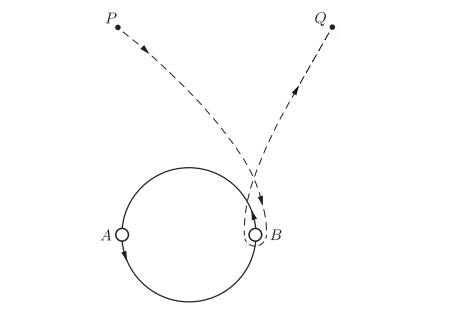
Image: This is Figure 1 from the Dyson paper. Caption: The solid line indicates the orbit of A and B; the dashed line indicates the orbit of C. Credit: Freeman Dyson.
Two options open up as we reach point Q:
At Q the mass C may be intercepted and its kinetic energy converted into useful form. Alternatively the device may be used as a propulsion system, in which case C merely proceeds with velocity 2V to its destination. The destination might be a similar device situated very far away, which brings C to rest by the same mechanism working in reverse.
Why call this a ‘machine’? Dyson speculated that if the advanced civilization would create ‘a whole ring of starting points P and end points Q’ around the same binary system, masses dropped into the system would emerge as a continuous stream of payloads, or cargo, or whatever. The point is that the energy source for this system is simply the gravitational potential between the two stars.
Then we can go further and extrapolate what happens as the machine continues to function. Over large timespans, the two stars will be drawn closer together, with the effect that their orbital velocity will necessarily increase. Thus the machine continues to operate, extracting energy from the system until the stars close to such a tight distance that no passage between them is possible. Dyson thinks this would be a point where the distance between the centers of the two stars is 4 times the radius of each star.
Dyson calculated that the luminous energy radiated by Sun-like stars in a three-body system like this would be a more practical source than gravitational energy, but white dwarfs, far less luminous than the Sun, would ramp up the gravitational energy by a factor of a hundred. So there’s an interesting technosignature for you, a search for white dwarf binaries with the parameters defined by Dyson, marking a system that could accelerate objects to 2000 kilometers per second without any propellant.
The ever imaginative Dyson thought such a system of white dwarf binaries scattered around the galaxy could serve as a long-haul freight transportation network. More significantly, he went on to consider the more condensed form of star known as the neutron star, which as the time of writing was still a theoretical concept. “[T]he fact that none has yet been observed does not argue strongly against their existence.” And of course, it would not be long before Jocelyn Bell and Antony Hewish found the first pulsar in 1967.
If we were to choose a pair of white dwarf stars as our binary system, Greg Matloff notes in The Starflight Handbook, we might reach velocities of 0.009 c. This is roughly 2700 kilometers per second, not bad given our Voyager 1 travel speed of a mere 17.1 kilometers per second. Even so, it’s a long way to Proxima Centauri. If we could work with a pair of neutron stars, according to the calculations Dyson made, we might reach 0.27 c,or almost 81,000 kilometers per second. Now we’re moving out, reaching Proxima in a couple of decades. Then, of course, we’ve got to slow down.
Adds Dyson:
…it may be said that the dynamics of stellar systems, under conditions in which gravitational radiation is important, is a greatly neglected field of study. In any search for evidences of technologically advanced societies in the universe, an investigation of anomalously intense sources of gravitational radiation ought to be included.
What an extraordinary thinker Dyson was! I look forward to the recent essay collection “Well, Doc, You’re In”: Freeman Dyson’s Journey through the Universe (MIT Press, 2022), just arrived here and placed at the top of my stack of necessary reading. Meanwhile, it’s intriguing to take the subject further still. Although Dyson didn’t push into this direction, Greg Benford has examined how truly advanced civilizations might create a different kind of gravitational machine to enable communications systems that would make using the electromagnetic spectrum seem quaint. More on that soon.
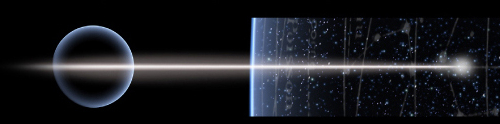
Apparent anti-gravity is described by Felber in arXiv:gr-qc/0505099 v2 6 Jun 2005
Hi Andrew
The problem with Felber’s anti-gravity effect is that it kicks in when objects are moving above 0.577 c. And only when they’re really, really moving does it become significant.
Hi Andrew & Paul
I have wondered over the years what happened to Felber’s concept. It didn’t originate with him apparently. Here’s a criticism of a similar claim:
https://www.sciencedirect.com/science/article/abs/pii/S0927650518302573?via%3Dihub
Courtesy of a search on Harvard’s ADS Server.
In THE SPACEFLIGHT HANDBOOK, did the authors confuse DM 61 + 366 for Gliese 710 as the star coming within .29 ly of us in a million years?
Hi Jeff
Gliese 833 is DM 61+366. That particular stellar flyby estimate is based on 40 year old astrometric data, which has been updated by Hipparchos and GAIA data since then. Gliese 833 is no longer consider a stellar near-miss.
But Gliese 710 is—both were to come by in a million years ago…
So, put a Felber ship in its path instead>
This installment came through loud and clear!
Thanks, Bill. Glad to know the system is back under control!