
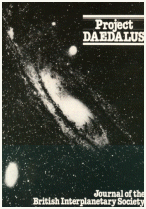
The Project Daedalus starship, designed by members of the British Interplanetary Society in the 1970s, was the first full-scale attempt to work out the parameters of a realistic interstellar mission. The target of this unmanned probe was Barnard’s Star, a red dwarf some 5.9 light years from Earth. The Daedalus team leader, Alan Bond, made a key assumption: technology had reached the point where an interstellar mission could be designed without assuming any further breakthroughs in physics.
The inertial confinement fusion techniques Daedalus would use have been the subject of much refinement in the days since and continue to be fertile ground for study. But the question I most often hear about Daedalus is, why Barnard’s Star, when the Alpha Centauri system is considerably closer? The answer is addressed in an article by astronomer Alan Boss (Carnegie Institution of Washington) that appears on the Astrobiology Magazine Web site. And it involves a planetary detection that only failed due to the limits of its instrumentation.
 The story goes back to astronomer Peter Van de Kamp, who in 1937 became director of Sproul Observatory at Swarthmore College. Van de Kamp began observing Barnard’s star the following year, taking 25 years worth of data in all before declaring there was evidence of a wobble in the star, one that would fit the profile of a planet about 1.6 times Jupiter mass orbiting at 4.4 AU. For about ten years, the idea that Barnard’s Star had at least one planet was in the air, influencing the Daedalus team and creating a ripple of interest that long preceded today’s active program of exoplanetary discovery.
Later work by Oliver Jensen and Tadeusz Ulrych went even further, suggesting the presence of three planetary companions of Jupiter size around the star (Astronomical Journal, Vol. 78, p. 1104, 1973). Unfortunately, followup studies by George Gatewood (University of Pittsburgh) and John Hershey (also at the Swarthmore College Observatory) found systematic errors in Van de Kamp’s work. Changes to the Swarthmore telescope, including a significant lens adjustment, were evidently the source. Hershey supplied the coup de grâce, using the Swarthmore instrument to find an identical wobble for the star Gliese 793, like Barnard’s Star an M-class dwarf.
Either both stars were orbited by an identical planet, or the telescope itself was the source of the erroneous data signature. Still unconvinced, Van de Kamp continued to study the star using completely new data, but without result. And much more recent work using the Hubble Space Telescope has revealed no convincing sign of planets.
For more on Daedalus, see A. R. Martin, ed., Project Daedalus Final Report. Supplement to the Journal of the British Interplanetary Society, 1978. We could use an updated new edition of this work to spare hapless researchers the task of making photocopies of several hundred pages of JBIS! Several papers in the Final Report consider the Barnard’s Star question. From Anthony Martin’s “Project Daedalus: the Evidence for Planetary Companions of Barnard’s Star:”
“However, since the above review [Jensen and Ulrych] was published, the situation has become less clear cut. Evidence for instrumental variations in the astrometric positions of a number of stars studied at the Sproul Observatory has been confirmed, although the amount of variation is appreciable for some stars and absent for others. Also, work by other astronomers…using more sophisticated approaches to reduction of observational data is not in very good agreement with the Sproul data.”
End of story, at least for now. What this suggests is that Barnard’s Star is probably not orbited by Jupiter-class planets within range of current detection methods, but it does not rule out smaller worlds that may only be found through more advanced instruments like the space-based Kepler.

0 Comments
Trackbacks/Pingbacks