
Last Saturday’s image of Proxima Centauri raised questions for several readers, who asked where Centauri A and B were in the photograph. The answer is that they are not in the field of view. To get a broader perspective, let’s step back a bit. In the image below, I’m using a photograph taken by Noël Cramer at the Observatoire de Genève. I’ve cropped the image to show the relative position of the primary Centauri stars and Proxima Centauri. If you look to the upper right of the image, you’ll see the tip of the red arrow that Cramer used to point to Proxima, which is otherwise indistinguishable.
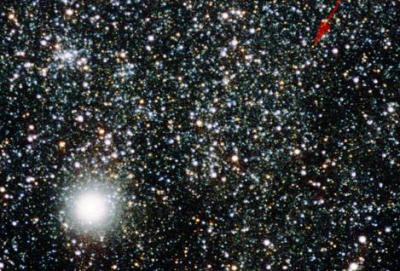
Now ponder the bright ‘star’ at lower left. It is actually not one but two stars, Centauri A and B. The two are so close to each other, and so close to us, that they effectively merge into a single image, which is why we talk about ‘Alpha’ Centauri — it was once thought to be simply the single brightest star in the Centaur constellation. Now, of course, we know it is a triple system, with the two major stars both Sun-like and theoretically capable of supporting an Earth-like planet in their respective habitable zones.
Consider the distance between the bright Centauri A and B duo and Proxima in the above image. You’re looking at 10,000 AU, about the distance between the Sun and the Oort Cloud in our own Solar System.
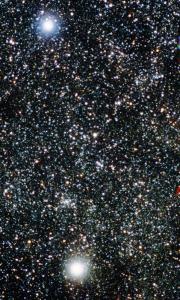 Let’s back out to see a fuller view of the Cramer photograph. Now we see a second bright star at the top of the image. This is Beta Centauri. Despite the confusing nomenclature, Beta Centauri is not part of the Alpha Centauri triple star system. In other words, it’s not Centauri B; it’s merely the second brightest star in the Centaur. Alpha Centauri is the ‘star’ at the bottom, and if you look at about the 2 o’clock position at the very edge of the image, you’ll see just the tip of the red arrow that Cramer used to mark Proxima Centauri.
One thing that would surely galvanize the interstellar effort is the discovery of a terrestrial world around one of the Centauri stars. If such a blue and green world swam into view one day (perhaps through the efforts of the Terrestrial Planet Finder mission), reaching another star would be elevated to serious consideration by the various agencies that map out future space missions. Perhaps more important, however, would be the energizing effect on a public that has grown all too blasé about breakthroughs in the cosmos.
Image credits: Noël Cramer, Observatoire de Genève.


Is Alpha Centauri viewable from north america and if so where would be the best location on the continent to view it? Thank you.
Hi Stan. Alpha Centauri is really a southern skies object, but should be viewable from southern Texas, Florida and Hawaii. The farther south you can get in the US, the better. Of course, best of all is a nice trip below the equator!
Is it true that our Sun is travelling towards Alpha Centauri along with our Solar System?
Sanjeev, I don’t know what our relative motion in relation to the Centauri stars is, but yes, our Sun and Solar System are indeed in motion. But the star that’s most interesting with regard to distance is Barnard’s Star. It’s approaching the Sun at a speed of 87 miles per second, a rate that will take it to within four light years of the solar system in 8,000 years (it’s currently 7.8 light years away).
paul thank you for the two interesting replies above…but did you know,i’m sure you did,lol,that in only 5 billion years there will be a big smack up between the andromeda galaxy and the milky way!!!!!!!! can you imagine when the andromeda galaxy is really close and we can see it in our nighttime sky!!!i’m glad i already have a good pair of astronomy binoculars. :) george
Alpha Centauri:
Radial velocity (Rv) -21.6 km/s
Proper motion (?) RA: -3678.19 mas/yr; Dec.: 481.84 mas/yr
Approaching somewhat in this direction but not toward us. Or, if you prefer, we are doing the moving.